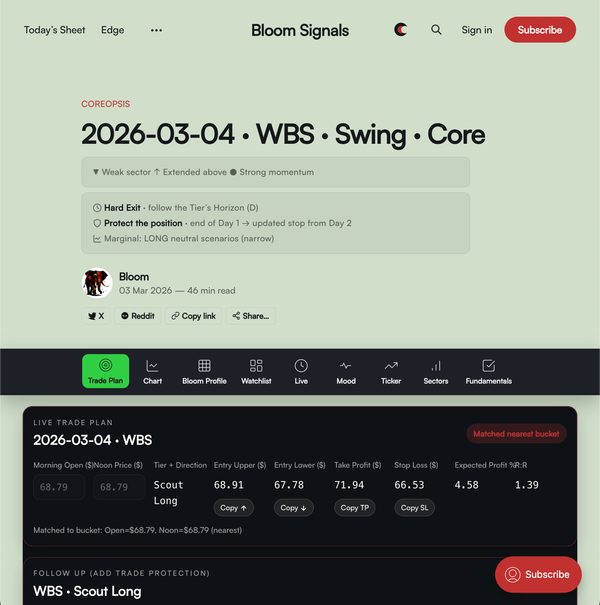
By 11:58 a.m. Eastern, your watchlist is full of “almost.” Almost breaking out. Almost holding support. Almost clean. The problem is that “almost” is where discipline goes to die—because you don’t have a rule that tells you where to enter, where you’re wrong, and when to walk away.
Bloom Signals was built to replace “almost” with structure: a curated daily list, a defined entry zone, and a decision window between noon and the close—enter only when the edge justifies the risk.
Coreopsis is a swing workflow for traders who prefer structure after the market shows its hand. You watch the open, track the morning trend, and decide—between noon and the close—whether price earns an entry. The engine behind that workflow is proprietary. We don’t publish source code. We don’t pretend secrecy is a virtue either.
Trust comes from something less glamorous: a paper trail.
That’s why older ticker articles remain free, and why retrospectives stay visible. The past should be easy to audit.
Why keep it proprietary at all?
Edges don’t like attention. When a fragile advantage becomes widely replicated, it compresses. Signals turn to noise, fills deteriorate, and the “system” becomes a crowded trade with prettier typography.
So Bloom Signals protects the modeling pipeline the way a good shop protects technique: not for mystique, but because copying is easy and quality control is not.
That still leaves the only question that matters:
How do you evaluate something you can’t fully inspect?
The trader’s version of trust
Traders don’t trust explanations. They trust repeatable behavior over time.
You’ve seen the alternative: a system appears with a few triumphant screenshots, vague rules, and suspiciously absent losing months. It performs until it doesn’t—then it reincarnates under a new name.
A public archive makes that harder.
With Bloom Signals, you can go back and check what was published before the market moved:
- entry zones,
- stops and targets,
- whether price actually reached the entry band,
- and the unglamorous category too many systems omit: NO ENTRY.
A real process produces “no trade” days. If price never comes into the band, the correct action is restraint. We treat that as a first-class outcome, not a footnote.
A story you’ll recognize
On March 21, 2025, CCI (Crown Castle) dropped sharply after the company terminated its CEO. No indicator “predicts” that announcement. The work is in how your plan handles the surprise.
Coreopsis doesn’t claim to manage your trade live. It publishes the structure—entry band, protections, exits—then you still do the job traders have always done: monitor news, manage risk, stay humble.
That is also why the archive matters. Markets introduce randomness. Your process shouldn’t.
What you can verify in five minutes
If you’re evaluating Bloom Signals, skip the adjectives and do a quick audit:
- Timing: Was the article published before the trade window?
- Trigger: Did price enter the Entry Lower/Upper band after 12:00 PM ET?
- Discipline: Are NO ENTRY days visible, or does it manufacture action?
- Realism: Do stops/targets look executable for the ticker’s volatility and liquidity?
- Regimes: Scroll through a choppy month, not just a trending one.
You’re not looking for perfection. You’re looking for a system that behaves like a system.
Why older articles are free
Keeping the archive open is product design. A proprietary model still needs accountability. The cleanest way to provide it is to let prospective users inspect a long stretch of historical outputs without paying first and asking questions later.
The model can remain proprietary while the record stays public. That’s the bargain.
In markets, the record has a quiet authority. It doesn’t persuade. It simply sits there, waiting for you to check.