
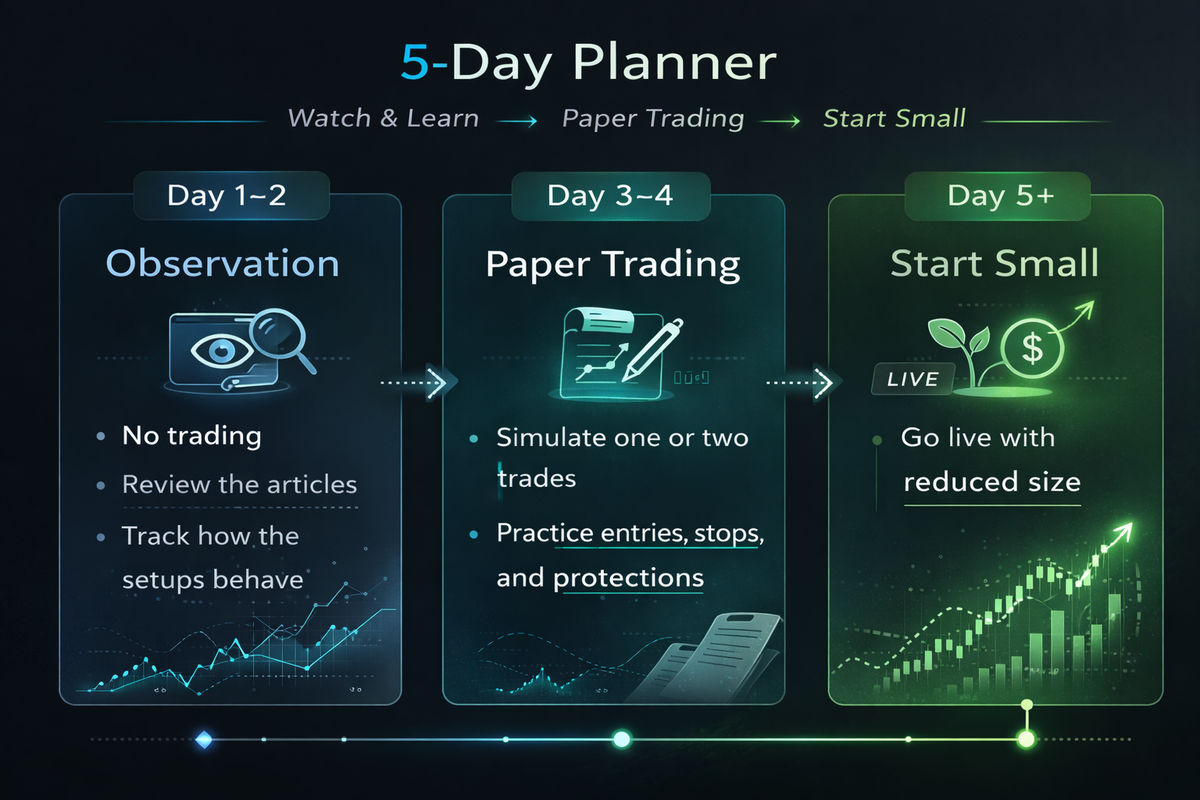
The first week is about building trust in the process and learning the rhythm—without letting impatience take over. You’re trying to build a repeatable workflow you can run for months.
Day 1–2: Observation (no trading)
Treat the first two days like onboarding.
What to do:
- Read every ticker article like you might trade it, but don’t.
- Note the entry zone (upper
↔lower), stop-loss, and take-profit (targets), then watch how price behaves around those levels. - Track outcomes in a simple log:
- Did price enter the zone?
- Did it respect the stop area?
- Did it tag Target 1 or Target 2?
- Did it chop sideways or trend cleanly?
What you’re learning:
- The “feel” of the setups: smooth vs. noisy names, gap behavior, and how often entries actually trigger.
- Whether the model’s levels match your style (patient entries, disciplined stops, realistic targets).
Rule of the phase:
- No execution. You’re calibrating expectations.
Day 3–4: Paper trading (simulate 1–2 trades)
Now you practice the mechanics with fake money and real rules.
What to do:
- Pick one or two setups
- Place simulated entries only if price behaves as described—don’t “force” fills.
- Execute the full lifecycle:
- Entry
- Stop placement
- Target 1 partial
- Target 2 / trail / exit logic (whatever the playbook says)
What “protections” means in practice:
- Hard stop: define the exit level and honor it.
- Position sizing: use smaller “paper size” but keep the risk model realistic (e.g., risk per trade).
- No averaging down: if the stop is hit, the trade is done.
- No chasing: missed entry = skip.
What you’re learning:
- Whether you can follow the rules under mild emotional load.
- Whether the trade management plan feels natural or forced.
Rule of the phase:
- Practice precision and timing.
Day 5+: Start small (go live with reduced size)
If observation and paper trades feel coherent, you can go live—but with training wheels on, because markets love humbling confidence.
What to do:
- Trade one setup (max two) with reduced size—think “boring small.”
- Use the same rules you paper-traded. No improvisation on Day 1 live.
- After the close, write a short debrief:
- Did you follow the plan?
- Did the plan make sense in real conditions (spread, slippage, emotions)?
- What would you change next time—process only, not outcome-based excuses?
How small is “small”?
- Small enough that a stop-loss feels like a note in a journal.
Rule of the phase:
- The goal is integration. Your job is to build a system you can repeat.
A simple one-week success metric
At the end of Week 1, success is:
- You understand the workflow.
- You can execute it without chasing or revenge trading.
- You have a log of observations and at least a couple clean simulations (and maybe one small live trade).
Profit is optional in Week 1. Discipline isn’t.